
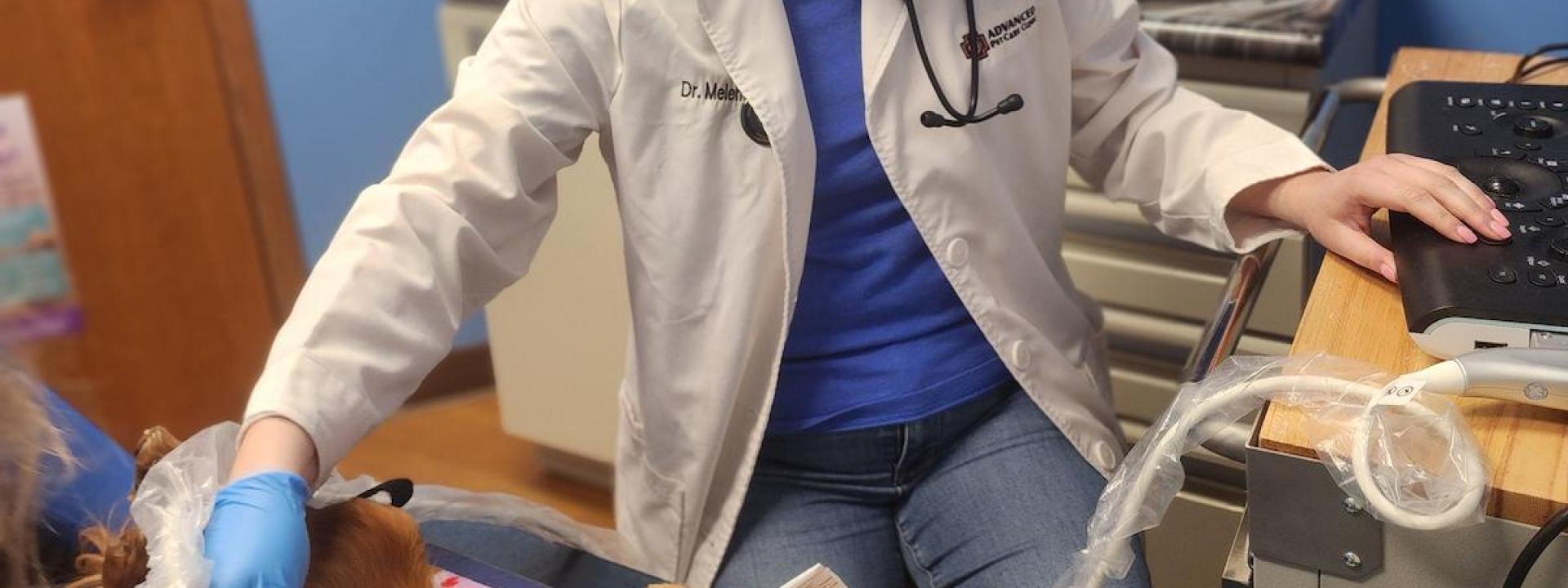
If your dog has been having ongoing digestive problems, losing weight, experiencing changes in appetite, or showing other signs that something is not right, a physical examination and laboratory tests can provide important information. Sometimes, however, our veterinarians need a closer look at what is happening inside your dog’s body.
That is where ultrasound can be valuable. An ultrasound for dogs allows us to examine internal organs and structures without surgery or radiation. It can provide information about internal organs and soft tissues that complements other diagnostic testing and helps us determine what additional testing or treatment your dog may need.
At Advanced Pet Care Clinic, Dr. Vivian Melendez performs comprehensive abdominal ultrasounds in our clinic, allowing many dogs to receive this diagnostic imaging without the need for a referral elsewhere.
Why Might My Dog Need an Ultrasound?
There is no single symptom that automatically means a dog needs an ultrasound. Instead, our veterinarians consider your dog's symptoms, physical examination, medical history, and results from other diagnostic tests.
An ultrasound for your dog may be recommended for concerns such as:
- Ongoing vomiting or diarrhea
- Unexplained weight loss
- Changes in appetite
- Abdominal pain or swelling
- Abnormal liver or kidney values on bloodwork
- Urinary problems
- A suspected mass or tumor
- Fluid in the abdomen
- Reproductive concerns
For example, bloodwork might tell us that your dog's liver or kidney values are abnormal, but it cannot show us what those organs look like. An ultrasound can provide another piece of the diagnostic picture by allowing us to examine their size, shape, appearance, and internal structure.
What Can a Dog Ultrasound Show?
Ultrasound uses high-frequency sound waves to create images of structures inside the body. Because the images are produced in real time, our veterinarians can examine internal organs in a way that is different from a still image.
During a comprehensive abdominal ultrasound, Dr. Melendez can evaluate organs and structures including the:
- Liver
- Kidneys
- Spleen
- Bladder
- Intestines
- Reproductive organs
An ultrasound can reveal changes in the appearance or structure of these organs and can help identify abnormalities such as masses or fluid accumulation.
An ultrasound does not always provide a final diagnosis by itself. If an abnormal area is found, additional testing may be necessary to determine exactly what is causing the change.
Ultrasound can also be used for reproductive purposes, including confirming pregnancy and evaluating developing puppies. While ultrasound can help assess fetal viability, it is not the most reliable way to determine the exact number of puppies in a litter.
How Is an Ultrasound Different from an X-Ray?
X-rays and ultrasound are different types of diagnostic imaging that provide different kinds of information. Depending on what our veterinarians need to evaluate, they may recommend an X-ray, an ultrasound, or sometimes both.
X-rays provide a static image and are particularly useful for evaluating bones as well as the size, shape, and position of certain organs and structures. Ultrasound is particularly useful for examining soft tissues and the internal appearance of abdominal organs. Because ultrasound provides images in real time, it can also allow us to observe movement within the body.
Ultrasound does have limitations. Sound waves do not travel well through air or bone, which means ultrasound is not the best imaging choice for every part of your dog's body.
The type of imaging our veterinarians recommend will depend on what they need to learn about your dog's condition.
What Happens During an Ultrasound?
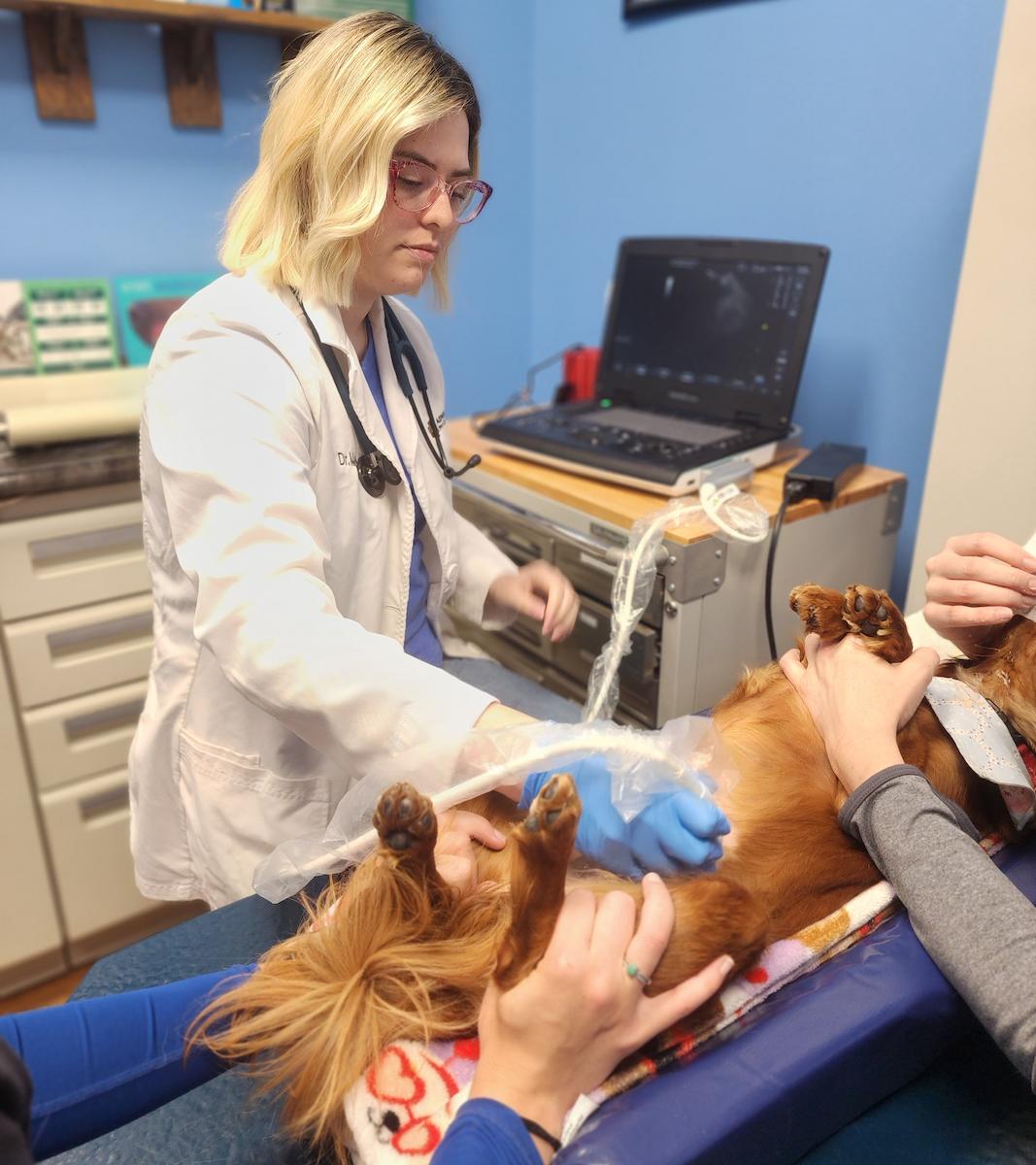
If your dog needs an abdominal ultrasound at Advanced Pet Care Clinic, the procedure is non-invasive and painless.
Your dog will typically lie on a padded surface for the examination. A small area of fur will be clipped because the ultrasound probe needs good contact with the skin to produce clear images. Gel is applied to the skin, and the probe is moved over the area being examined.
As Dr. Melendez performs the ultrasound, images of your dog's internal organs appear on a screen where she can evaluate them in real time.
Most dogs tolerate an ultrasound well, and sedation is rarely required at Advanced Pet Care Clinic. However, every dog is different. Sedation can sometimes be appropriate if a dog is very anxious, uncomfortable, or has difficulty remaining still. If your dog is already uncomfortable because of the medical problem being investigated, our team will take that into consideration throughout the examination.
What Happens After the Ultrasound?
Once the ultrasound is complete, Dr. Melendez will review the findings and discuss what they mean for your dog.
Sometimes an ultrasound helps clarify the cause of symptoms or provides information that guides treatment. In other cases, it identifies an abnormality that needs further investigation. Additional bloodwork, testing, or other diagnostics may be recommended depending on what the ultrasound shows.
Ultrasound can also be useful after a diagnosis has been made. For some ongoing conditions, repeat imaging can help us monitor changes and evaluate how your dog is responding to treatment.
In-House Ultrasound at Advanced Pet Care Clinic
When your dog is not feeling well, waiting for answers can be difficult. Having ultrasound available at Advanced Pet Care Clinic gives our veterinarians another diagnostic tool to help determine what may be happening inside your dog's body.
Dr. Vivian Melendez has completed advanced training in veterinary ultrasonography and performs comprehensive abdominal ultrasounds in our clinic. Providing this service locally can reduce the need for referral in many cases and help us move more quickly from identifying a problem to discussing the appropriate next steps.
If your dog has unexplained symptoms or our veterinarians have recommended an ultrasound, contact Advanced Pet Care Clinic to schedule an appointment. An ultrasound for your dog can provide valuable information that helps us better understand the problem and determine what comes next.
Frequently Asked Questions About Ultrasound for Dogs
Does my dog need any special preparation before an ultrasound?
Preparation can depend on the type of ultrasound and what our veterinarians need to examine. Our team will give you specific instructions before your dog's appointment, including whether there are any restrictions on food or water.
Why does my dog's fur need to be shaved for an ultrasound?
The ultrasound probe needs close contact with the skin to produce clear images. Fur can trap air between the probe and the skin and interfere with the sound waves, so a small area generally needs to be clipped.
Can an ultrasound find cancer in a dog?
An ultrasound can sometimes reveal a mass or other abnormal changes that raise concern, but an ultrasound image alone cannot always determine whether an abnormality is cancer. Additional testing, which may include obtaining a sample of cells or tissue, can be necessary for a diagnosis.
Is ultrasound safe for dogs?
Ultrasound is considered a safe, non-invasive form of diagnostic imaging. It uses sound waves rather than ionizing radiation to examine internal organs and structures.